
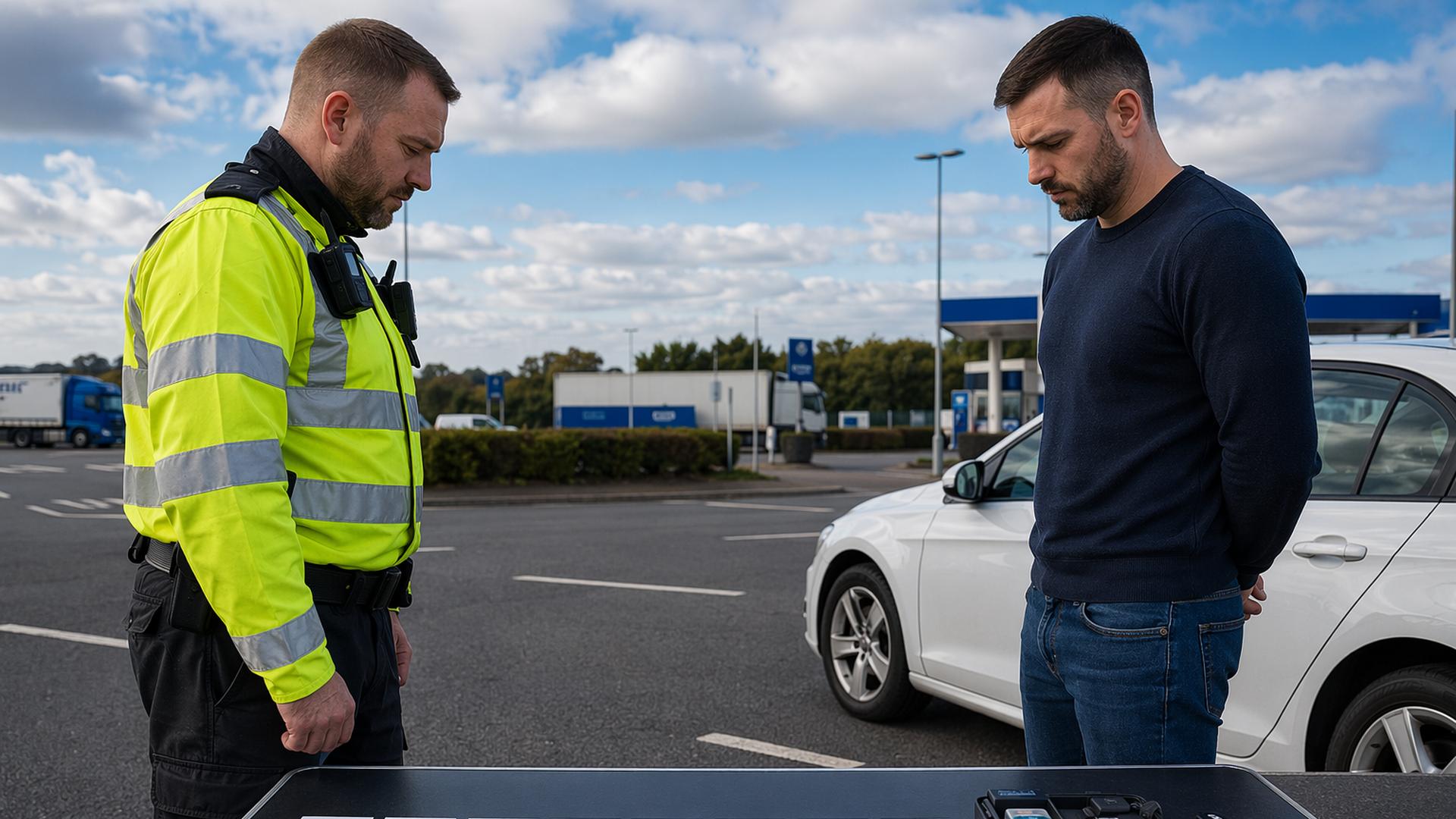
7 Serious Consequences of Failing a Roadside Drug Test in the UK
Published by Drug Driving Solicitors — specialist defence lawyers for drug driving charges across England and Wales.
Failing a roadside drug test is a moment that can feel overwhelming, particularly if you are unsure of what comes next. The process that follows is structured, with each stage carrying its own legal significance, and understanding how it unfolds is the first step toward protecting yourself effectively.
This article walks through the seven key stages that typically follow a positive roadside drug screening in England and Wales. Each stage is explained in plain terms, so that whether you have just been through this experience or are trying to understand what a loved one is facing, you can approach the situation with clarity and confidence.
1. You Are Arrested and Taken to a Custody Suite
When the circumstances of a roadside stop meet the legal threshold for arrest, a police officer will formally detain you under Section 5A or Section 4 of the Road Traffic Act 1988. This is not necessarily a sign that the matter is already decided against you; rather, it is the procedural gateway through which the next stages of the investigation must pass. The arrest triggers a set of rights and protections that work in your favour if exercised properly.
Once arrested, you will be transported to a custody suite at a nearby police station. There, a custody sergeant will read you your rights, record your detention, and ensure that you are aware of your entitlement to free legal advice. This is a right you should exercise without hesitation. Speaking to a solicitor before anything further happens can make a material difference to the outcome of your case.
The custody suite environment can feel disorientating, particularly if it is your first encounter with the criminal justice system. It is important to remain calm, cooperate with the procedural requirements that apply to you, and avoid making any detailed statements about the events of the day before obtaining legal advice. Anything you say in custody can and will be used as part of the investigation.
What Happens During the Custody Process
During your time in custody, the following steps will typically be completed:
- Your personal property will be recorded and stored
- A custody record will be opened in your name
- You will be informed of the reason for your detention
- You will be offered access to free and independent legal advice
- A healthcare professional will be called to conduct a further examination
The custody process is designed to be thorough and documented at every step. Those records can later become relevant if procedural errors need to be identified as part of a legal defence.
2. The Blood Sample Is Sent for Laboratory Analysis
Once the blood sample has been taken, it does not yield a result immediately. The sample must be packaged, labelled, and dispatched to a forensic laboratory that has been nominated by the relevant police force. This process introduces a waiting period that is often one of the more anxiety-inducing aspects of the entire experience for those involved.
Laboratory analysis is carried out using highly sensitive scientific methods, typically liquid chromatography-tandem mass spectrometry, which is capable of identifying and quantifying specific substances against the legal limits set out in Schedule 2 of the Drug Driving (Specified Limits) (England and Wales) Regulations 2014. These limits are expressed in micrograms per litre of blood and vary depending on the substance involved.
The time taken for results to be returned can range considerably, from several weeks to several months, depending on the laboratory's current workload and the complexity of the analysis required. During this period, neither the police nor the defendant will typically have access to the findings, and the investigation is effectively in a holding pattern.
Understanding the Legal Limits Being Tested
The laboratory will assess the sample against limits set for specific controlled and medicinal drugs. Some of the most commonly encountered threshold substances include:
- Delta-9-tetrahydrocannabinol (cannabis): 2 micrograms per litre of blood
- Cocaine: 10 micrograms per litre of blood
- Benzoylecgonine (cocaine metabolite): 50 micrograms per litre of blood
- MDMA (ecstasy): 10 micrograms per litre of blood
- Clonazepam: 50 micrograms per litre of blood
- Morphine: 80 micrograms per litre of blood
Each of these figures is a hard legal threshold. A reading above the limit does not necessarily lead to a conviction, but it does mean the evidential stage of the process has been engaged.
3. The Officer Administers a Statutory Warning
Before a roadside drug screening swab can lawfully be taken, the officer conducting the test is legally required to administer what is known as a statutory warning. This is a specific, prescribed caution that informs the driver that the device being used is approved for the purpose of detecting drugs, and that a positive result may lead to further testing and potential prosecution. It is not a formality that can be dispensed with.
The statutory warning requirement exists to protect the rights of the driver and to ensure that the evidence gathered is obtained lawfully. If the warning is not delivered in the correct form, or if there is any ambiguity as to whether it was properly given, this can become a significant point of challenge in subsequent proceedings. It is one of several procedural safeguards that specialist solicitors examine carefully when reviewing a case.
Officers are trained to administer the warning as part of the roadside procedure, and most do so correctly. However, the pressure of a live roadside stop, combined with the variability of individual practice, means that errors do occasionally occur. Those errors are not always obvious to the driver at the time.
Why the Statutory Warning Matters to Your Defence
The statutory warning is more than procedural housekeeping. Its proper administration can affect:
- The admissibility of the roadside screening result
- The integrity of the chain of evidence from roadside to laboratory
- The ability of the prosecution to rely on the positive reading as a foundation for further action
- Whether the case can be challenged at an early stage before reaching court
A specialist drug driving solicitor will review the officer's notes, body-worn camera footage, and custody records to verify that this requirement was met. In cases where it was not, the consequences for the prosecution's case can be substantial.
4. Your Case Is Heard at the Magistrates' Court
Drug driving offences under Section 5A of the Road Traffic Act 1988 are summary offences, which means they are heard in the Magistrates' Court rather than the Crown Court, unless exceptional circumstances apply. If you have been charged, you will receive a court date and will be required to attend in person, unless your solicitor has made arrangements for you to be represented in your absence at an early administrative hearing.
At the Magistrates' Court, the case will proceed either as a guilty plea or a contested trial. If you are pleading guilty, the court will move to sentencing relatively quickly, taking into account any mitigating factors that your solicitor has prepared and presented. If the matter is contested, the court will hear evidence from the prosecution and, where relevant, from the defence, before reaching a verdict.
The magistrates have sentencing powers that include a mandatory minimum disqualification of twelve months, an unlimited fine, up to six months' imprisonment in the most serious cases, and the requirement to sit an extended driving test before a licence can be restored. These outcomes are not inevitable, however, and the quality of your legal representation plays a significant role in how the court approaches your case.
Sentencing Factors the Court Will Consider
When determining the appropriate sentence, the magistrates will weigh a range of circumstances, including:
- The level of the drug detected relative to the legal limit
- Whether there is any evidence of impairment at the time of driving
- The defendant's previous driving and criminal history
- The impact of disqualification on employment or family responsibilities
- Whether a guilty plea was entered at the earliest opportunity
- Any cooperation shown throughout the investigation
A well-prepared mitigation statement, submitted through a specialist solicitor, can influence the court's approach to the length of the disqualification and the level of any fine imposed.
5. The Roadside Device Produces a Positive Reading
The roadside drug screening process begins with a small saliva swab, taken using a type-approved device such as the Dräger DrugTest 5000. These devices are approved by the Secretary of State for specific drugs, meaning they can only be lawfully used as a screening tool for the substances they have been certified to detect. A positive reading does not in itself constitute proof of a criminal offence; it is a trigger for a more detailed investigation.
Type-approval matters because it is a safeguard against unreliable technology being used as a basis for arrest and prosecution. The device must be approved for the specific drug it purports to detect, and using a device outside its approved scope is a procedural error that can be identified and challenged. This is one reason why understanding which device was used, and for which substances, is an early and important question in any drug driving case.
The driver has the right to see the result displayed on the device. A positive reading will typically prompt the officer to move swiftly to the next stage of the process, but the manner in which the test was conducted, the conditions under which the sample was taken, and the calibration status of the device may all become relevant to any subsequent challenge.
Common Drugs Detected at the Roadside
Type-approved devices can currently screen for a number of controlled substances, including:
- Cannabis (THC)
- Cocaine
- Opiates such as heroin and morphine
- Amphetamines and methamphetamine
- Benzodiazepines
- MDMA
It is worth noting that some prescription medications can, in certain circumstances, interact with roadside screening devices. If you were taking prescribed medication at the time of the test, this is an important detail to raise with your solicitor at the earliest opportunity.
6. A Healthcare Professional Takes a Blood Sample
Once you arrive at the custody suite and the procedural requirements have been met, a forensic medical examiner or other qualified healthcare professional will be asked to attend. Their role is to take a blood sample from you, which will serve as the definitive evidential specimen for the purposes of the investigation. This is a clinical procedure conducted in accordance with established protocols, and it replaces the roadside saliva reading as the primary basis for any charge.
The healthcare professional is not a police officer, and their role is independent. They will take two portions of the blood sample: one is retained by the police and sent for laboratory analysis, and the other is offered to you. Accepting your portion of the sample is strongly advisable, as it gives your solicitor the opportunity to commission an independent analysis if the prosecution's laboratory result is disputed.
Before the blood sample is taken, the officer must formally require the specimen from you under Section 7A of the Road Traffic Act 1988. This requirement must be made in a specific way, and any deviation from the prescribed procedure is another area that a specialist solicitor will scrutinise. The blood sample, if properly taken and analysed, will either confirm or contradict the roadside screening result.
Your Rights During the Blood Sample Procedure
You are entitled to certain protections during this stage of the process:
- The sample must be taken by a qualified healthcare professional, not a police officer
- You must be offered your own portion of the blood sample
- The sample must be taken and stored in accordance with documented protocols
- The chain of custody from collection to laboratory must be recorded and maintained
- Any failure in these procedures can be raised as a challenge by your defence team
Understanding these rights is not about obstructing the process. It is about ensuring that the evidence gathered against you has been obtained fairly and in accordance with the law.
7. You Are Charged or Told No Further Action Will Be Taken
Once the laboratory results have been received and reviewed by the investigating officer and, in many cases, the Crown Prosecution Service, a decision will be made as to whether to proceed with a charge or to take no further action. This is often referred to as the NFA decision, and it is the point at which the investigation either advances to court or is brought to a close.
A charge will be brought if the laboratory analysis confirms that a controlled or specified drug was present in your blood above the legal limit and the CPS considers there to be a realistic prospect of conviction and that prosecution is in the public interest. The threshold for the second condition is typically met in drug driving cases, meaning the key question is usually whether the evidential threshold has been satisfied.
If no further action is taken, it may be because the laboratory result did not exceed the legal limit, because a procedural error undermined the integrity of the evidence, or because the CPS exercised its discretion not to proceed. Receiving an NFA notice does not always mean that no issues arose; it simply means that the investigation will not proceed to prosecution at that time.
What to Expect After a Charge Is Issued
If a charge is issued, the process moves into its court-facing phase. At this point:
- You will receive a charge sheet detailing the specific offence alleged
- A date will be set for your first appearance at the Magistrates' Court
- Bail conditions may be imposed, which could include restrictions on driving
- You will need to confirm your plea, either in person or through your solicitor
- Your legal representative will begin preparing your case in full
This stage is when specialist legal representation becomes particularly important. The difference between an unprepared and a well-prepared approach to sentencing or a contested trial can be significant, both in terms of outcome and the long-term consequences for your driving record, insurance premiums, and employment prospects.
What Comes Next: Taking Stock After a Drug Driving Investigation
Navigating the stages that follow a failed roadside drug test can feel like moving through a process that is both unfamiliar and high-stakes. Each step, from the initial positive reading through to a potential court hearing, carries its own procedural requirements, rights, and opportunities for challenge. Understanding those stages does not remove the stress of the experience, but it does mean that you are better placed to engage with it constructively.
The most effective thing anyone in this position can do is seek specialist legal advice as early as possible. Many of the most powerful challenges to a drug driving case arise from procedural errors that are only visible to a trained eye, and the window to identify and raise those issues is often time-limited. A specialist solicitor will not simply prepare you for the worst; they will look carefully at every stage of the process to find where the case against you may be weaker than it appears.
Frequently Asked Questions
What Is a DG10 and How Long Does It Stay on My Licence?
DG10 is the DVLA offence code assigned to the standard drug driving offence under Section 5A of the Road Traffic Act 1988, specifically for driving or attempting to drive with a controlled drug present in the blood above the legal limit. Once recorded on your driving licence following conviction, it remains visible for eleven years from the date of that conviction. Any insurer running a check against the DVLA database will be able to see it, and the effect on insurance premiums is typically significant. A specialist solicitor can advise on the broader implications of a DG10 for your personal circumstances, including any impact on employment, professional licensing, or international travel.
What Happens if I Refuse to Give a Blood Sample at the Custody Suite?
Declining to provide a blood sample without a reasonable excuse is a separate criminal offence in its own right, created by Section 7A of the Road Traffic Act 1988. The penalties mirror those for a drug driving conviction and include the same mandatory twelve-month driving ban. The definition of a reasonable excuse is narrowly drawn, and any medical justification must be supported by proper evidence. Refusing on the basis of a hunch, a fear of needles, or general reluctance will not amount to a reasonable excuse. If you are considering refusing, or have already done so, speak to a solicitor before taking any further steps.
What Should I Do in the Days Immediately Following a Failed Roadside Drug Test?
The period between the roadside stop and any formal charge is often the most valuable time to take protective steps. Write down everything you can remember about the stop while it is fresh, including the officer's exact words, the device used, whether you were offered your portion of the blood sample, and any concerns you had about how the test was conducted. Gather any relevant medical records if prescribed medication was involved. Do not discuss the matter on social media or with anyone other than your legal adviser. Contact a specialist drug driving solicitor as early as possible, even before any charge is issued, as early advice can shape the outcome significantly.
What If the Drug Found in My Blood Was Prescribed by My Doctor?
A statutory medical defence is available under Section 5A(3) of the Road Traffic Act 1988 for drivers who are able to demonstrate that the drug was prescribed or supplied to them by a medical professional, that they took it in accordance with the advice given, and that their driving was not impaired. While this defence does exist in law, it is narrower in practice than many people assume and requires careful evidential preparation to succeed. It is not sufficient simply to produce a prescription. Drug Driving Solicitors has particular expertise in cases involving prescription medication and can advise on whether the defence is available and how best to present it.
What Are the Most Common Reasons Drug Driving Charges Are Dropped?
Several grounds can lead to a charge being discontinued or a case collapsing before or during trial. The most frequently encountered include: the statutory warning not being administered correctly before the roadside swab was taken; the use of a screening device that was not type-approved for the specific drug in question; failures in the documented chain of custody for the blood sample; the defendant not being offered their portion of the blood sample; errors or inconsistencies in the laboratory analysis; and an unlawful stop or search. A specialist solicitor will systematically review all of these issues from the outset, not simply accept the headline laboratory result at face value.
How Long Does It Take From Failing a Roadside Drug Test to Being Charged?
The timeline varies, but most people can expect the process to take somewhere between two and six months from the date of the incident to a charging decision, and in some cases considerably longer. The primary cause of delay is the laboratory analysis of the blood sample, which is dependent on the nominated laboratory's capacity and current case volume. Once the laboratory report is received, the decision to charge or take no further action is typically made within a shorter timeframe. If six months have passed and you have not received any communication about the outcome, it is advisable to seek specialist legal advice to understand where matters stand.
Drug Driving Solicitors is a dedicated law firm focusing exclusively on drug driving cases throughout England and Wales. If you have received a positive roadside drug test result and want to understand where you stand, contact us today for a free initial consultation, or visit drugdrivingsolicitors.co.uk. Getting advice at the earliest stage costs nothing and can be the single most important step you take toward achieving the best possible outcome in your case.